Expansion without black holes
Expansion without black holes - it it possible? In the early universe, phenomena such as black holes should not have existed. Based on the Big Bang theory, the universe expanded quite dramatically and rapidly. Scientists have proposed a term for this phenomenon: Cosmic inflation. Of course, these are only our assumptions, which we must constantly verify. The James Webb Space Telescope provides us with data for verification. However, what James Webb Space Telescope has provided us with has puzzled researchers. Something that seemed impossible has become observational confirmation. See more in the link.
The image now created by JWST's observations of space is changing our views on the early universe and, at the same time, forcing us to verify our knowledge about the origin of our universe. Perhaps further research will be even more astonishing. We have attached the cited article to our post. At the end of this article, we will also present our interpretation of what James Webb Space Telescope has discovered and provided. Could black holes be part of the expansion "vector" of our Universe?
Sourse: https://www.quantamagazine.org/a-single-naked-black-hole-rewrites-the-history-of-the-universe-20250912/?mc_cid=5f08276057&mc_eid=386c697863
It must be admitted that the James Webb Space Telescope data surprised us. Now scientists are looking for an explanation. At the same time, further questions can be raised. Could black holes be part of the expansion "vector" of our Universe? We will also try to deal with everything that James Webb Space Telescope has provided us with and present our own vision - our concept, which is just one voice in the discussion.
Expansion without black holes - According to our Concept
The earliest empirical observation of an expanding universe is known as Hubble's law, published in work by physicist Edwin Hubble in 1929, which discerned that galaxies are moving away from Earth at a rate that accelerates proportionally with distance. Independent of Friedmann's work, and independent of Hubble's observations, in 1931 physicist Georges Lemaître proposed that the universe emerged from a "primeval atom," introducing the modern notion of the Big Bang. Scientists did not expect that black holes could exist in the early universe.
The concept of expansion is an interpretation of the universe's development. No one has said why the expansion must take this course, or whether there are any quantum-level conditions for the expansion to take this exact course — in other words, whether there is such a thing as quantum expansion, and whether this expansion directly or indirectly influences our universe's expansion. Another way to pose the problem is: is the universe's expansion a result of phenomena occurring at the quantum level? If so, then perhaps we are also experiencing expansion at the quantum level?
According to our Concept — ToE–Quantum Space,, the expansion of the Universe has several components. This means that the expansion process is more complex than we think. Depending on one's perspective, the expansion can take on different scenarios. According to our concept, the expansion appears to be more complex than we think. First of all, we distinguish other types of expansion, such as:
- Vertical Expansion
- Horizontal Expansion
- Quantum Expansion
If we were to view the expansion of the Universe as a process of infinite growth, it is Black Holes that violate this principle. Where a Black Hole exists, a defect in the Expansion of the Universe occurs. Normally, everything expands, but where a Black Hole exists, the Expansion loses meaning — it's as if it had to suddenly stop. It is the Black Hole that introduces such a massive disruption that the information carried by the photons into further, expanding regions of space is irretrievably lost. From our perspective, of course. However, our Concept of Expansion differs here.

First, there can be no disruption of expansion. The universe, according to the interpretation of the Big Bang Theory, must expand according to the principle of isotropy. The principle of isotropy of space states that for a fundamental observer located at Earth's current location, matter in the sky is distributed isotropically, meaning that in every direction the observer sees the same amount of matter, which, in cosmological terms, means that galaxies evenly cover the sky.
The principle of isotropy would certainly be violated if our observer were looking in a direction where all, or most, of the supermassive black holes were lined up in a row (in a single line that defines the direction of observation). This seems quite likely if we are looking in the direction of the beginning of our Universe (direction of observation, observation and expansion).
A black hole could therefore create a discontinuity in the expansion of the universe. Where the black hole occurs, a singularity could occur, which would cause a discontinuity in the expansion. To prevent this discontinuity in the expansion of the universe, vertical expansion occurs at the location of the singularity (black hole).
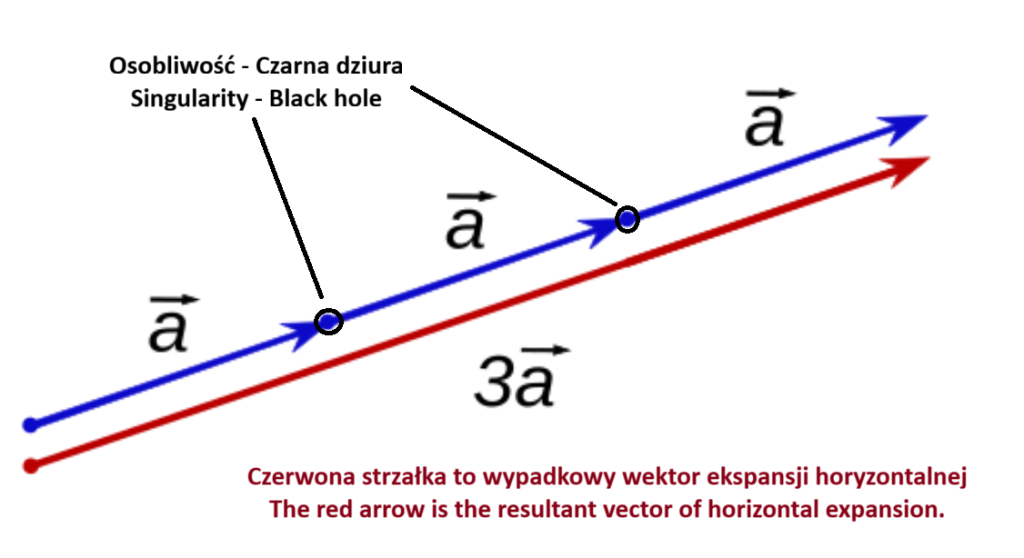
It seems that our expansion must be ongoing, in a permanent manner. Such assumptions ensure the proper development of our Universe. Therefore, if a singularity stands in the way of expansion, the process of the Universe's development can be interrupted. To avoid this, at the point of discontinuity – the occurrence of a singularity – an imaginary expansion occurs. We have called this type of expansion: Vertical Expansion. Vertical Expansion occurs only at the point of a singularity.
Expansion without black holes? According to our Concept of time
Well, according to our Concept — ToE–Quantum Space, inside a black hole there is information gathered from the beginning of our Universe to the moment of its end. The question is, can this information be useful? What if the information inside a black hole tends toward a single state of the Universe — toward a description of the first moment of our Universe’s existence? Could it be that in the first moment of existence, it was possible to exist without basic attributes: without time, without space, without energy and without matter? Perhaps at that time there was only unity, a mysterious bond between time, space, energy and matter.
If the first moment described by Primary Information presented an interpretation of the unification of time, space, energy and matter, then this description must converge to a single point—the moment of the first Primary Information. Therefore, if our Universe has a Beginning and an End, then according to our Concept — ToE–Quantum Space, the Primary Information for the First and Last Moments are convergently the same — even though their values are different. This means that the sequence for the End of the Universe must converge to a single value. This value appears to be the same, although in reality they are not equal.
Entropy is central to the second law of thermodynamics, which states that the entropy of an isolated system left to spontaneous evolution cannot decrease with time. As a result, isolated systems evolve toward thermodynamic equilibrium, where the entropy is highest. A consequence of the second law of thermodynamics is that certain processes are irreversible.
Geometry for relativity theory can play a key role for our concept of gravity. Does this mean that today’s mathematical models based on geometry will have an impact on the development of what Albert Einstein started? We don’t know exactly how geometry will change if our concept of time changes.
Quantum Mechanics has its own rules. One of the rules is the uncertainty principle. It seems that the indeterminacy principle must have different rules for the concept of time – time at the quantum level functions quite differently. This means that the concept of time in quantum mechanics can usefully introduce a different description of phenomena at the quantum level. If that were the case, then we would also have to factor in macro-scale phenomena.
In order for a feature, an attribute of the Universe to appear, which will enable the description of our Universe using laws, information must first appear. Information was the first trigger for subsequent features of the Universe, which can be used to describe our Universe. It was information that united four attributes: time, space, energy and matter. Information originally had to be some form of energy of a type unknown to us. Only then, were the individual attributes of the description of our Universe released from information. The first attribute to be released was time.
At the beginning of everything there had to be Information.
Marek Ożarowski


Komentarze
Prześlij komentarz